Perovskite-based Solar Cells for Earth and Space
The Aydin Group's research on high-efficiency, stable and space-ready perovskite photovoltaics has been featured in a new LMU Munich research story highlighting the potential of perovskite materials for future energy technologies.
Read the full LMU feature →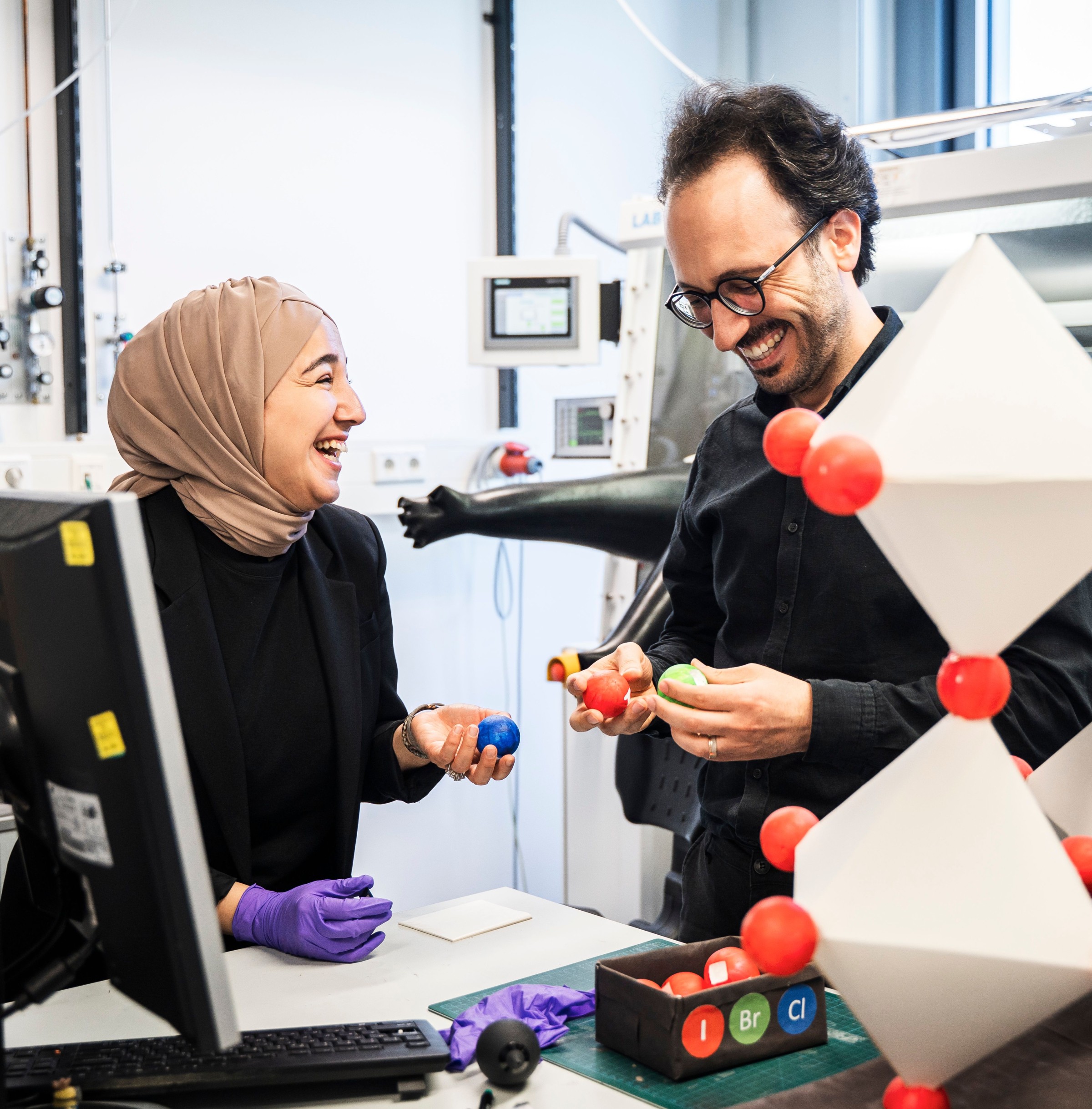
We are pleased to share that the Aydin Group at LMU Munich has been featured in a new research story published by Ludwig-Maximilians-Universität München, exploring how perovskite materials are opening new possibilities for future energy technologies and photovoltaics.
The feature highlights our work on developing high-efficiency and highly stable perovskite solar cells, with research spanning advanced materials, interfaces, tandem photovoltaics and the development of solar cells capable of operating under the demanding conditions encountered in space.
We’re primarily developing fundamental materials and device principles needed to solve challenges that industry cannot yet address.
Dr. Erkan AydinUltra-thin materials, extraordinary potential
One of the features that makes perovskites particularly attractive is their ability to absorb sunlight efficiently while being processed as extremely thin semiconductor layers. As highlighted by LMU, the thin-film components used in our solar cells are generally less than two micrometers thick.
This combination of strong optical absorption, tunable electronic properties and thin-film processability creates opportunities for photovoltaic devices that are lightweight, versatile and adaptable to different substrates and applications.

Understanding the interfaces that determine performance
Our research combines materials chemistry, interfacial engineering, device physics and advanced processing to develop photovoltaic technologies that are not only highly efficient, but also reliable under realistic operating conditions.
A central part of this work is understanding how molecular and nanoscale interfaces influence the performance, stability and mechanical reliability of complex photovoltaic architectures.
Perovskite–silicon tandems for higher efficiency
A central focus of the Aydin Group is the development of perovskite–silicon tandem solar cells. By combining a perovskite top cell with a silicon bottom cell, the two materials can be optimized to harvest different portions of the solar spectrum.
The LMU feature highlights the rapid progress of this technology. In the laboratory, single-junction perovskite cells can now exceed 27% efficiency, while the best perovskite-based tandem cells have reached efficiencies of around 34%.
Perovskite solar cells for space
Beyond terrestrial photovoltaics, the Aydin Group is developing perovskite-based solar cells specifically for space applications.
Solar cells operating in orbit must withstand a combination of challenging conditions, including intense radiation, ultraviolet light, vacuum and rapid temperature fluctuations between sunlight and shadow.
Our research therefore goes beyond efficiency. We investigate how materials, interfaces and device architectures respond to these extreme environments and how their reliability can be improved for long-term operation.
From laboratory efficiency to space-ready performance
The aim is to develop perovskite photovoltaic components that retain their performance under the harsh environmental conditions encountered in space.

From efficiency to long-term reliability
Achieving high efficiency is only one part of the challenge. For perovskite photovoltaics to move from the laboratory towards widespread application, the devices must maintain their performance over long periods under realistic operating conditions.
This is why stability and reliability are central themes of our research. We investigate degradation mechanisms across the materials, interfaces and complete device architecture, while developing strategies to improve the robustness of perovskite solar cells.
High efficiency is only meaningful when it can be maintained.
We develop materials and interfaces that allow perovskite-based photovoltaic devices to operate reliably under demanding thermal, optical and environmental conditions.
Solar cells and quantum technology of the future: LMU researchers embrace perovskites
The full LMU feature explores the broader potential of perovskites for future energy technologies and optoelectronics, including research from the Aydin Group on high-efficiency photovoltaics, tandem solar cells, stability and space applications.
Read the full LMU story →