Welcoming Dr. Junke Wang to our Solar Energy Seminar Series with talk on Perovskite Multijunction Solar Cells
May 18, 2026
We were honored to host Dr. Junke Wang as the 15th speaker of our Solar Energy Seminar Series (SES Series). Dr. Wang is a rising leader in next-generation photovoltaic research, currently based at the University of Oxford and soon to join the South China University of Technology (SCUT) as an Assistant Professor — a well-deserved recognition of his outstanding contributions to the field.
His seminar offered a compelling look into the frontier of all-perovskite multijunction solar cells — a technology that could shatter the efficiency ceiling of conventional single-junction devices while preserving the cost advantages of solution-processed manufacturing. Dr. Wang walked us through the fundamental challenge of morphological and compositional disorder in wide-bandgap perovskite films, and presented elegant mitigation strategies through templated crystal growth that push open-circuit voltages toward their theoretical limits. The demonstration of monolithic quadruple-junction perovskite devices with efficiencies beyond 27% at 1 cm² was a particular highlight, illustrating just how rapidly this sub-field is advancing.
Beyond the formal presentation, we had a stimulating opportunity to brainstorm around open research questions in perovskite photovoltaics — from interfacial engineering and long-term operational stability to scalable deposition pathways. The discussion also opened promising avenues for potential collaboration, and we look forward to exploring these together in the months ahead.
Abstract
Perovskite multijunction photovoltaics: materials, interfaces, and device platforms
All-perovskite multijunction solar cells promise to deliver power conversion efficiencies (PCEs) beyond the theoretical limit of single-junction devices at low fabrication costs. However, the sub-par performance of wide-bandgap perovskite subcells remains a key bottleneck limiting the efficiency gains of tandem architectures. In this presentation, Dr. Wang discusses how initial morphological and compositional disorder in as-deposited Br-rich, wide-bandgap perovskite films can be the primary cause of VOC losses and stability issues in high-bandgap perovskite solar cells. Mitigation strategies based on templated growth of Br-rich perovskites improve halide homogeneity and suppress energetic losses, achieving open-circuit voltages approaching 90% of the theoretical limit across photovoltaic bandgaps ranging from 1.8 to 2.3 eV. Building on these advances, the work demonstrates efficient monolithic all-perovskite double-junction, triple-junction, and quadruple-junction solar cells with PCEs beyond 27% at a 1 cm² device area.
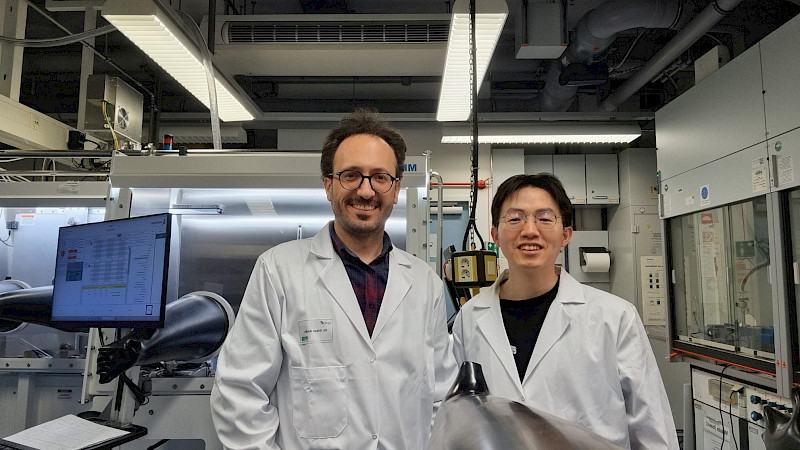
Dr. Erkan Aydin and Dr. Junke Wang in PV Fabrication Lab
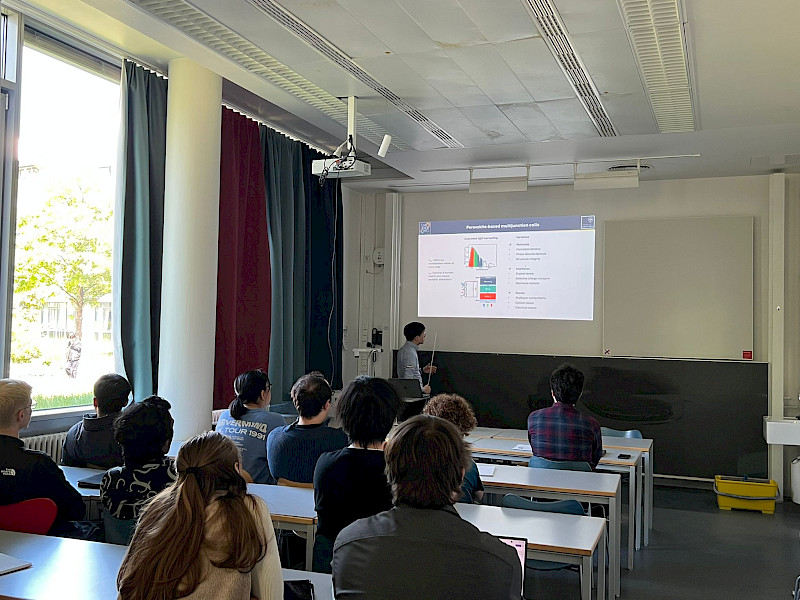
A scene from the talk of Dr. Junke Wang