New Publicaiton in Joule: Halogen-Enhanced Conjugated SAMs Enable Improved Charge Extraction in Textured Tandem Architectures
December 11, 2025
The Aydin Group at LMU Munich has published its first fully LMU-fabricated perovskite–silicon tandem solar cell, marking an important milestone for the team and the university’s growing solar-energy research program. The study, titled “Enhanced charge extraction in textured perovskite–silicon tandem solar cells via molecular contact functionalization,”is now available online in Joule.
This achievement is the result of a highly collaborative effort across LMU, bringing together expertise in physical chemistry, materials synthesis, spectroscopy, device physics, and computational modeling. The project involved close interactions with multiple internal teams and external partners, showcasing the strength of interdisciplinary research at LMU.
The work focuses on improving charge extraction at the critical perovskite/Si interconnecting junction by engineering self-assembled molecular contacts (SAMs). The team discovered that trace brominated impurities in a commercial SAM unexpectedly enhanced device performance. Building on this insight, the researchers synthesized a brominated conjugated SAM and developed an optimized binary molecular mixture tailored for textured silicon surfaces.
The newly designed SAMs enable denser surface coverage, improved interfacial passivation, reduced lattice strain, and enhanced charge extraction, particularly on rough, industrially relevant textures. These improvements translated into higher fill factors and a power conversion efficiency of 31.4% on Czochralski silicon bottom cells.
Beyond the scientific findings, this publication represents a major step forward for LMU’s in-house tandem fabrication capabilities. It demonstrates that LMU can now design, synthesize, fabricate, and characterize high-performance perovskite–silicon tandem devices entirely within its own research environment.
This milestone underscores the rapid progress of LMU’s solar-energy research community and sets the stage for future advances driven by molecular engineering and interfacial design.
Curious about the details? The full study is freely available here (Open Access)
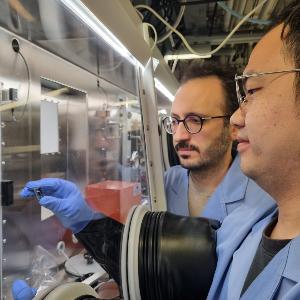
LMU News • 12 Dec 2025
Photovoltaics: Molecular fine tuning increases efficiency of solar cells
A molecular redesign of self-assembled monolayer contacts allowed LMU researchers to raise perovskite–silicon tandem cell efficiency to 31.4% and improve stability — a step forward for high-performance photovoltaics.
Article by Ludwig-Maximilians-Universität München. Image © Aydin Group / LMU
Read the article
An international research collaboration involving City University of Hong Kong, LMU Munich, SUSTech, KAUST and others has advanced perovskite-silicon tandem photovoltaics by engineering self-assembled monolayers (SAMs) at the interface. By designing conjugated and bromine-functionalized SAM molecules with improved coverage and energy alignments, the team achieved a certified tandem power-conversion efficiency of 31.4% along with enhanced stability and reproducibility under prolonged operation. Subtle molecular modifications at the buried interface were shown to control recombination dynamics and promote high performance. :contentReference[oaicite:0]{index=0}
Read the full article »
Scientists at Ludwig-Maximilians-Universität München and collaborators have developed tailored molecular contacts that boost the power conversion efficiency of perovskite-silicon tandem solar cells to 31.4 percent. By engineering self-assembled monolayers to enhance charge transport and interface quality, the team achieved higher efficiency and stability, demonstrating the importance of molecular-level design in advanced photovoltaics. The findings were published in Joule and mark a significant step toward high-performance tandem solar technology. :contentReference[oaicite:0]{index=0}
Read the full release on EurekAlert! »