Our New Publication in Nature Communications: Improving Thermal Fatigue Resistance of Perovskite Solar Cells for Space
March 9, 2026
Our group has published a new study in Nature Communications demonstrating a strategy to improve the resistance of perovskite solar cells to extreme temperature cycling—an important step toward their use in space environments.
The work, titled “Perovskite solar cells with enhanced thermal fatigue resistance under extreme temperature cycling,” addresses a critical durability challenge for next-generation photovoltaic technologies. While metal halide perovskite solar cells offer exceptional power-to-weight ratios and low manufacturing costs, their stability under repeated exposure to large temperature fluctuations—common in space environments—has remained poorly understood.
Understanding Thermal Fatigue in Space Conditions
In low Earth orbit, solar cells experience rapid and repeated transitions between extreme temperatures. To study this effect, we developed an accelerated thermal cycling protocol between −80 °C and +80 °C, closely mimicking the thermal stresses encountered in space.
Our experiments revealed that the mismatch in thermal expansion between the perovskite absorber layer and the glass substrate creates mechanical strain during temperature swings. This strain leads to degradation particularly at:
-
the substrate–perovskite interface, and
-
grain boundaries within the perovskite film
Both regions represent mechanically vulnerable parts of the device stack.
A Molecular “Suspension System” for Perovskite Solar Cells
To address these failure mechanisms, we introduced a dual molecular reinforcement strategy.
The approach combines:
-
α-lipoic acid and dihydrolipoic acid additives, which undergo in-situ polymerization during thermal annealing, strengthening cohesion between perovskite grains.
-
A sulfonium-based molecular derivative that chemically modifies the interface and significantly improves adhesion between the perovskite layer and the substrate.
These molecular building blocks—featuring sulfur, thiol, and sulfonium functional groups—form strong interactions with the perovskite lattice. Together they act like a molecular suspension system, stabilizing the structure against thermomechanical stress during repeated temperature cycling.
Performance and Stability Improvements
With this strategy, the devices achieved:
-
Stabilized efficiencies of ~26% under standard solar illumination
-
84% efficiency retention after 16 extreme temperature cycles between −80 °C and +80 °C
Interestingly, the study revealed that thermal exposure time plays a more critical role than the number of cycles, with most degradation occurring during the earliest cycles. This insight guided the design of a new in-house experimental setup that enables more realistic testing conditions for space environments.
Multiscale Mechanical Characterization
To understand the mechanical behavior of the devices, we carried out adhesion and mechanical analyses across multiple length scales:
-
PeakForce Atomic Force Microscopy to probe nanoscale mechanical adhesion
-
Pull-off adhesion tests to quantify interfacial strength at millimeter and centimeter scales
These measurements confirmed that molecular engineering significantly enhances both grain-boundary cohesion and interfacial adhesion, two key factors controlling thermal fatigue resistance.
International Collaboration
This work was performed through collaborations with several international partners, including researchers at:
-
Tianjin University
-
Technical University of Munich
-
King Abdullah University of Science and Technology
-
Fraunhofer Institute for Solar Energy Systems
-
Marmara University
Their contributions included advanced materials characterization and theoretical analysis supporting the molecular design strategy.
Part of the ERC INPERSPACE Project
The research is part of the INPERSPACE project, funded by the European Research Council under the Horizon Europe program (Grant Agreement No. 101077006). The project aims to develop ultra-efficient and durable perovskite solar cells tailored for space applications.
Beyond the immediate results, this study establishes a general framework for addressing thermomechanical degradation in perovskite photovoltaics, highlighting the importance of strengthening mechanically vulnerable regions within multilayer solar cell stacks.
Read the Article
The article is open access and available here:
https://www.nature.com/articles/s41467-026-70293-7
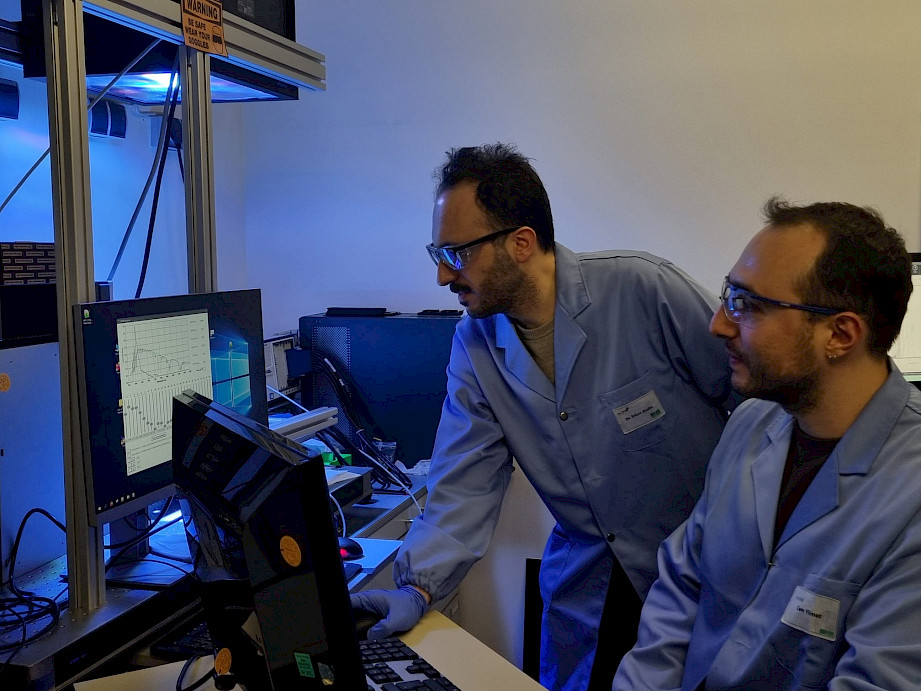
Cem Yilmaz and Erkan Aydin are checking the cell performances with the LED solar simulator in our lab. ©Aydin Group
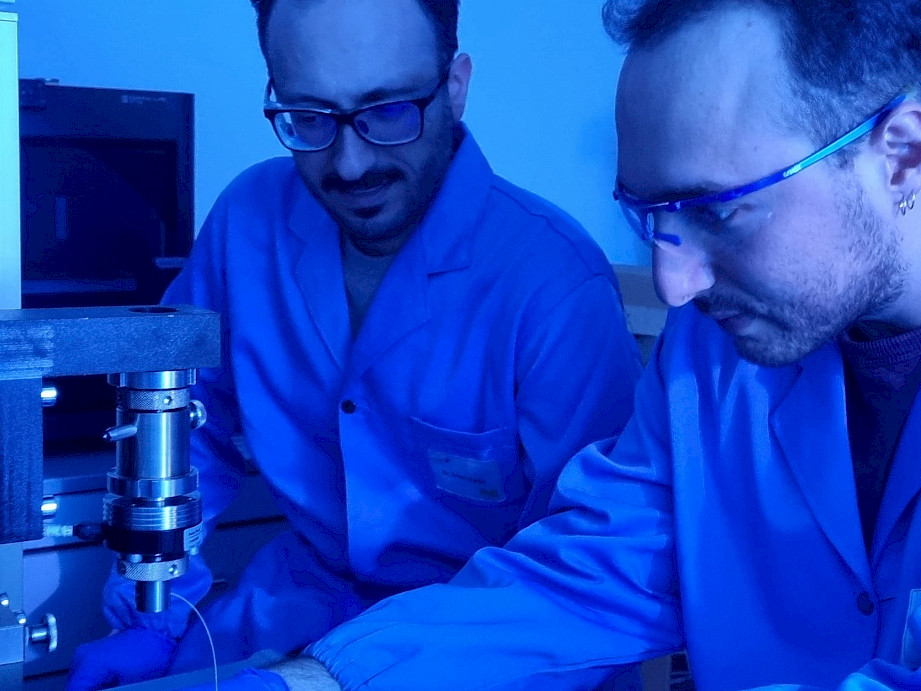
Cem Yilmaz and Erkan Aydin are preparing for the setup for pull-off tests in our lab. ©Aydin Group
Scientists Build High Temperature-Resistant Perovskite Solar Cell with 26% Efficiency
A research team led by LMU Munich has developed a dual molecular reinforcement strategy that allows perovskite solar cells to withstand the extreme thermal cycling of Low Earth Orbit. By strengthening grain boundaries with α-lipoic acid, the cells maintain high performance even after repeated fluctuations between -80°C and +80°C.
Read More at PV Magazine →Molecular Reinforcement Boosts Perovskite Solar Cells' Resistance to Extreme Temperatures
New research highlights a "dual-reinforcement" strategy to combat delamination in perovskite solar cells. By using molecular anchoring to bridge the gap between layers, scientists have created a durable "net" that keeps solar cells functional even under the intense thermal stress of space environments.
Read More at Perovskite-InfoHigh-Efficiency Perovskite Solar Cells for Low Earth Orbit
Interesting Engineering reports on a major leap for space-based solar power. Using a molecularly anchored net, researchers have developed perovskite solar cells that remain stable during the rapid temperature shifts of Low Earth Orbit, maintaining over 26% efficiency and proving resilient against the vacuum of space.
Read Article at Interesting Engineering