Prof. Randi Azmi Visits Our Gorup and Delivers the 18th SES Series Talk on Stable and Scalable 2D/3D Perovskite Solar Modules
November 2, 2026
Prof. Randi Azmi Discusses Stable and Scalable 2D/3D Perovskite Heterojunctions
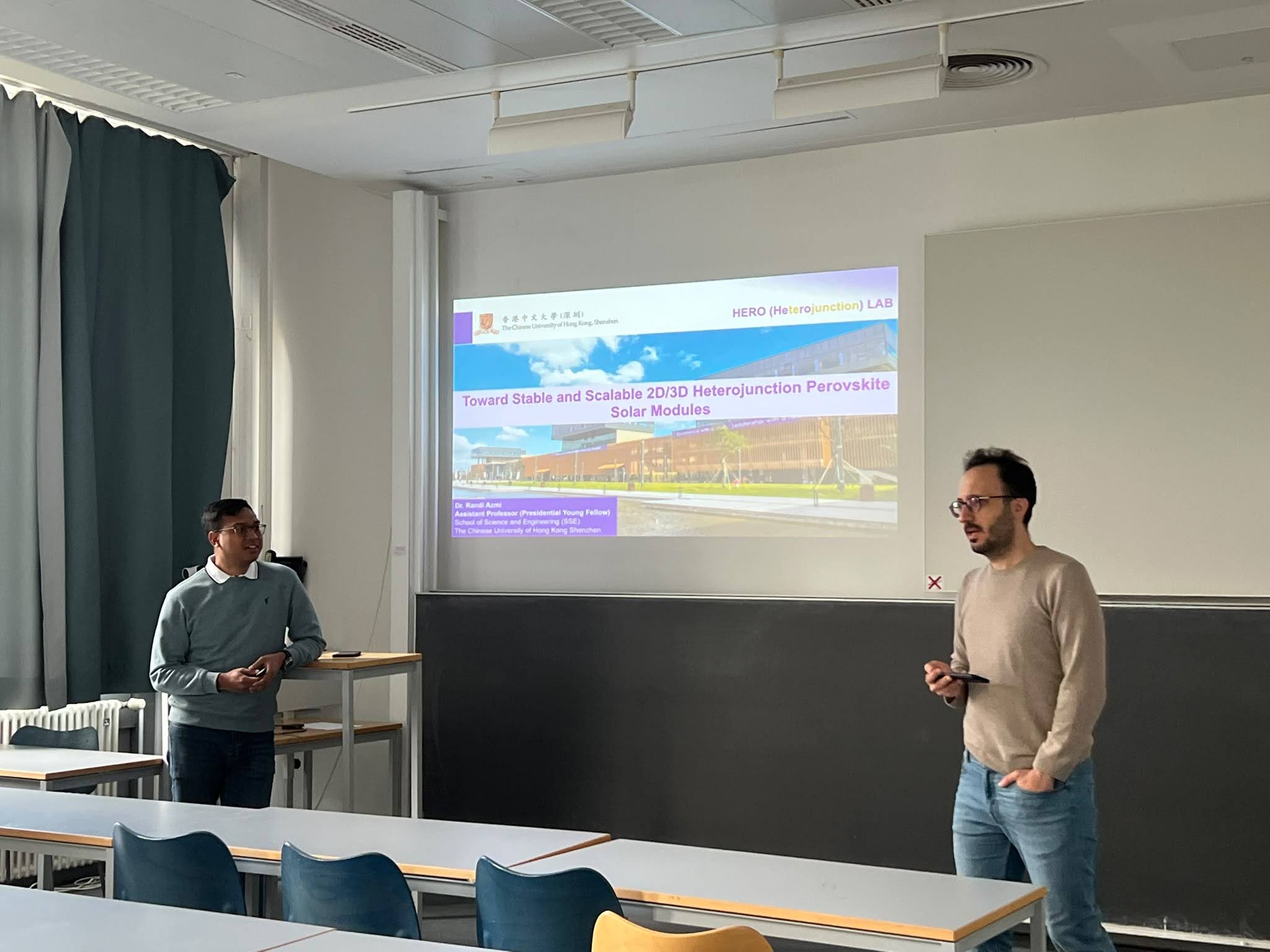
The Aydin Group welcomed Prof. Randi Azmi from The Chinese University of Hong Kong, Shenzhen, for the 18th talk of the Solar Energy Seminar Series (SES Series) at LMU Munich. His presentation explored strategies for improving the stability and scalability of perovskite solar modules through 2D/3D heterojunction engineering.
Toward Stable and Scalable 2D/3D Heterojunction Perovskite Solar Modules
In his invited talk, Prof. Azmi addressed one of the central challenges in perovskite photovoltaics: improving long-term stability while maintaining high performance as devices move towards larger areas and scalable manufacturing.
Although perovskite solar cells have achieved power conversion efficiencies approaching those of crystalline silicon, defects at the surfaces and grain boundaries of three-dimensional (3D) perovskite films can introduce charge traps and contribute to performance degradation.
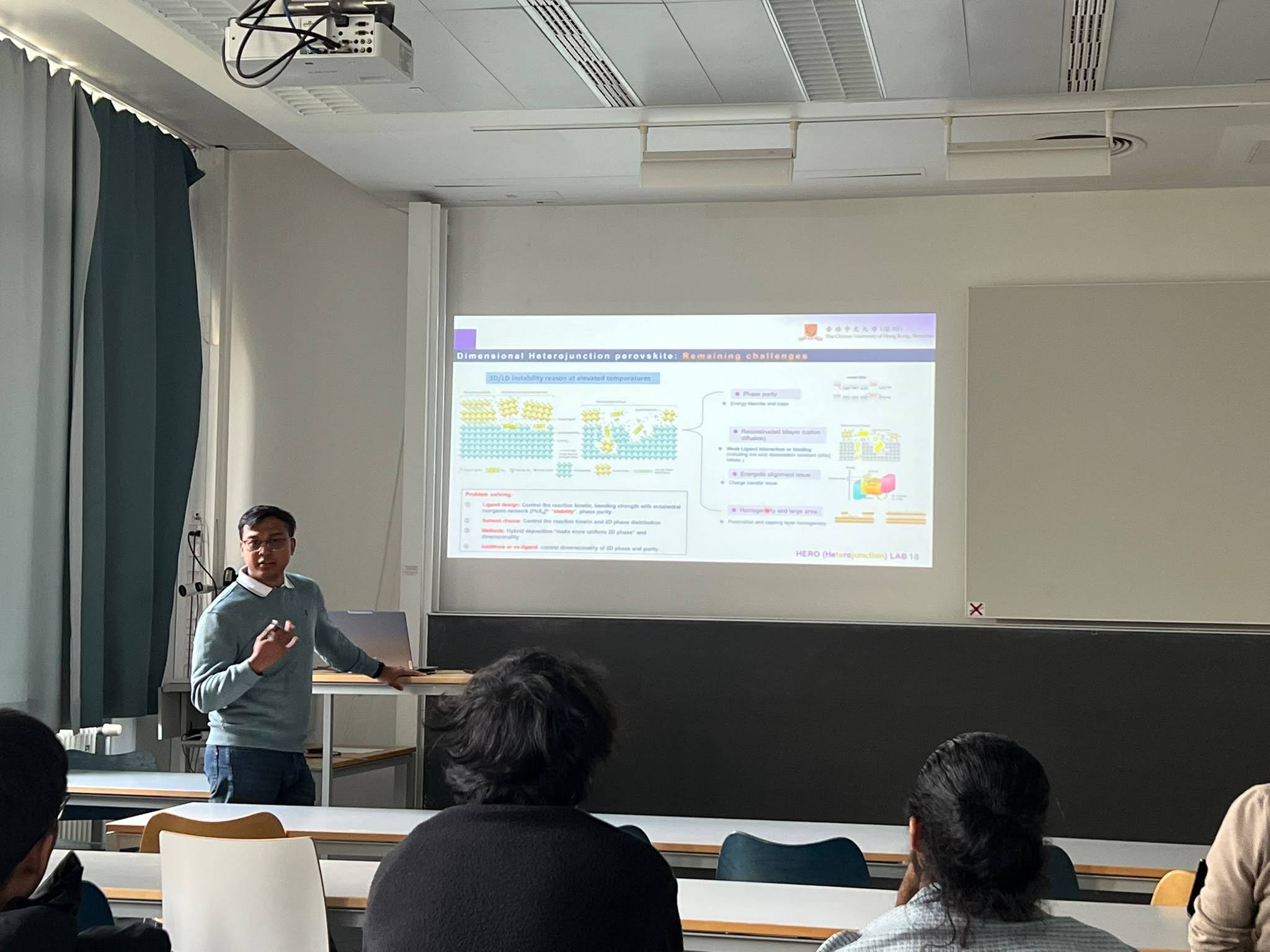
Prof. Azmi presented strategies to transform defective surface regions, including residual non-active δ-FAPbI₃ and PbI₂ phases, into low-dimensional perovskite (LDP) structures at the interfaces of 3D perovskite films. Through careful ligand design and fabrication optimisation, these dimensional heterojunctions provide effective surface passivation, reducing non-radiative recombination through field-effect passivation and robust chemical bonding.
The presented approach enabled high-quality capping layers with controlled phase purity, orientation, and coverage. The resulting devices achieved power conversion efficiencies of up to 28% for small-area devices and 21.5% for large-area devices (700 cm²). Prof. Azmi also discussed enhanced operational stability under maximum-power-point tracking at 1-sun illumination and elevated temperatures, highlighting the potential of this approach for scalable perovskite photovoltaic technologies.
Impressions from the 18th SES Series Talk
About Prof. Randi Azmi
Prof. Randi Azmi is an Assistant Professor (tenure-track) at the School of Science and Engineering, The Chinese University of Hong Kong, Shenzhen, where he leads the Heterojunction Materials for Renewable Energy Lab (HEROLAB).
He received his PhD summa cum laude from Kookmin University, South Korea, in 2020. He subsequently worked as a research scientist at UNIST and held postdoctoral and research scientist positions at the KAUST Solar Center in Saudi Arabia. His research group focuses on developing stable, scalable, and sustainable ("3S") single- and multijunction thin-film solar cells. His contributions to 2D/3D heterojunction perovskites have been published in leading journals, including Science, Nature, and Nature Reviews Materials.
He has also received the ASEAN and Indonesia Young Scientist Awards.
A familiar scientific connection
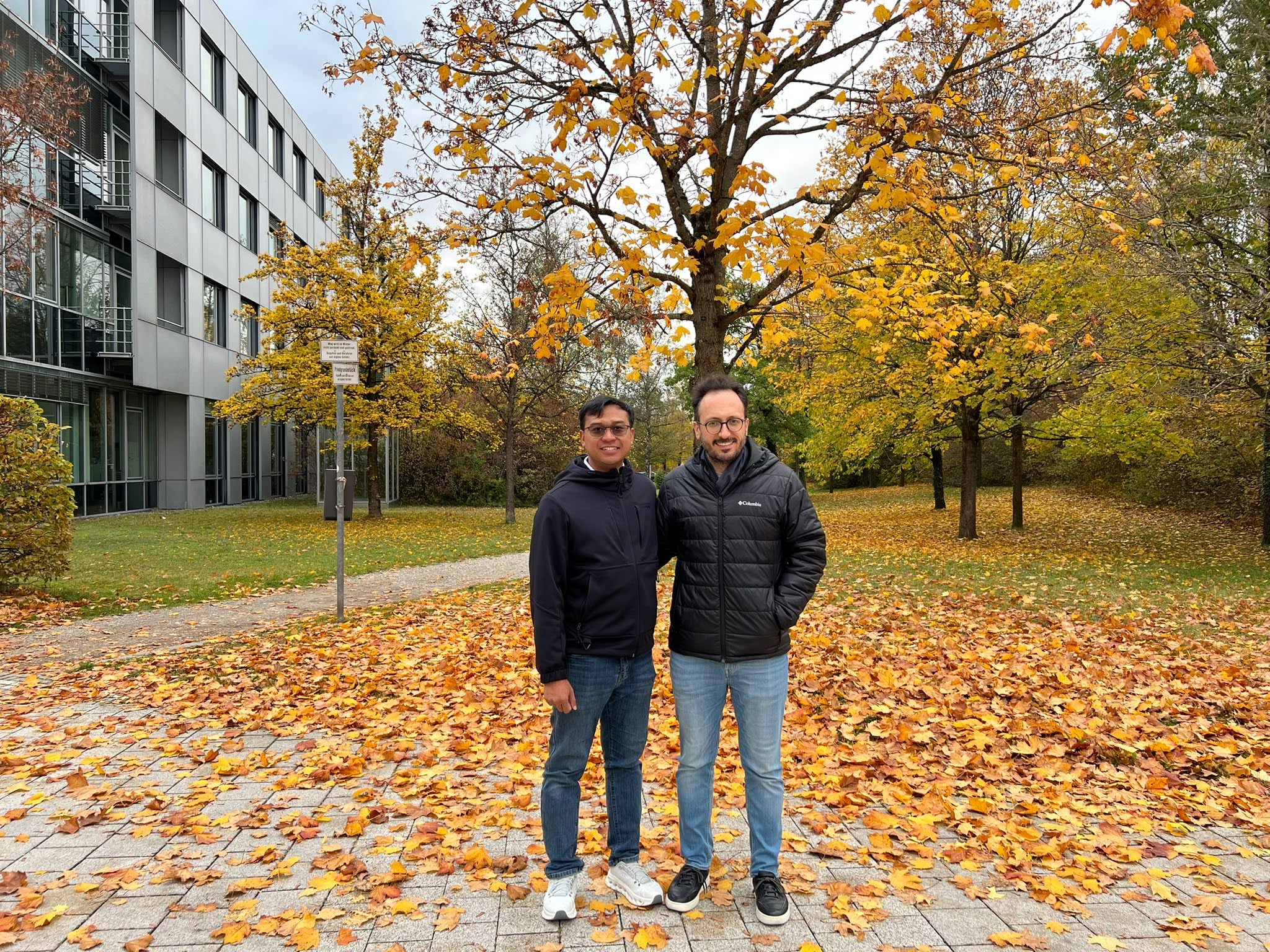
The seminar also provided an opportunity to reconnect with a former colleague. Erkan Aydin and Prof. Randi Azmi previously worked together at the KAUST Solar Center between 2020 and 2023, before continuing their research activities at different institutions.
It was a pleasure to welcome Prof. Azmi to LMU Munich and to continue the scientific exchange in the context of the SES Series.
Thank you, Prof. Azmi, for an insightful seminar. We appreciate your visit and the stimulating discussions on interface engineering, perovskite heterojunctions, and the challenges of translating high-efficiency devices into stable, scalable solar modules.