Space Photovoltaics
Historically, space utilization was limited to a few key applications such as telecommunications, weather monitoring, and navigation, resulting in relatively modest demand for spacecraft photovoltaics. Recent privatization of the space sector, however, has dramatically reduced launch costs—by a factor of ~23 over the past decade—and enabled ambitious initiatives such as mega satellite constellations (OneWeb, Starlink, and the European Union’s mega constellation), which plan to deploy over 100,000 satellites into low Earth orbit (LEO)—17 times the current global total.
This transformation creates a paradigm shift for space photovoltaics, moving from a high-cost, low-demand model to a low-cost, high-demand environment, demanding high-efficiency, lightweight, and reliable solar technologies.
Our group is at the forefront of this field, with a dedicated research program in space photovoltaics that leverages our expertise in perovskite and tandem solar cells. We focus on ultra-efficient multijunction perovskite-based tandems, engineered to perform under the extreme conditions of space, including high radiation flux, large temperature swings, and vacuum.
Our laboratory infrastructure is uniquely suited for this work: we possess state-of-the-art facilities for thin-film deposition, encapsulation, and device characterization, along with specialized equipment for accelerated space-relevant stress testing, such as radiation (national facilities), thermal cycling, and high-vacuum measurements. This enables us to systematically bridge the gap between laboratory-scale efficiency and robust performance in real space conditions.
Supported by a prestigious ERC Starting Grant, our research program aims to demonstrate space-ready tandem solar cells with unprecedented efficiency and stability. The outcomes of this work will not only advance the capabilities of next-generation satellites but also provide critical technological foundations for sustainable space infrastructure, renewable energy applications beyond Earth, and other emerging space technologies that will benefit humankind in the coming decades.
Related Publications
Energy Fuels 2025, 39, 22, 10134–10149
Small Methods 2025, 2401003.
Advanced Energy Materials 2025, 2404617.
Involved Researchers

Ali Buyruk
Butenandtstr. 5 - 13
Room E3.005
81377 München
Phone +49 89 2180-77608
Email: ali.buyruk@cup.lmu.de
High-efficieny perovskite-based solar cells with enhanced thermomechanical stability
Formerly a Postdoctoral Researcher in Aydin Group

Rik Hooijer
Butenandtstr. 5 - 13
Room E3.005
81377 München
Phone +49 89 2180-77608
Email: rik.hooijer@cup.uni-muenchen.de
2D/3D heterojunctions for efficient and stable multijunction solar cells

Jian Huang
Butenandtstr. 5 - 13
Room E3.005
81377 München
Phone +49 89 2180-77608
Email: jian.huang@cup.uni-muenchen.de
Ultra-efficient perovskite/silicon tandem solar cells

Cem Yilmaz
Butenandtstr. 5 - 13
Room E3.005
81377 München
Phone +49 89 2180-77608
Email: cem.yilmaz@cup.uni-muenchen.de
Thermomechanical analysis of multijunction solar cells

Hao Zhu
Butenandtstr. 5 - 13
Room E3.005
81377 München
Phone: +49 89 2180-77608
Email: hao.zhu@cup.uni-muenchen.de
Ultra-efficient all-perovskite tandem solar cells
Related News
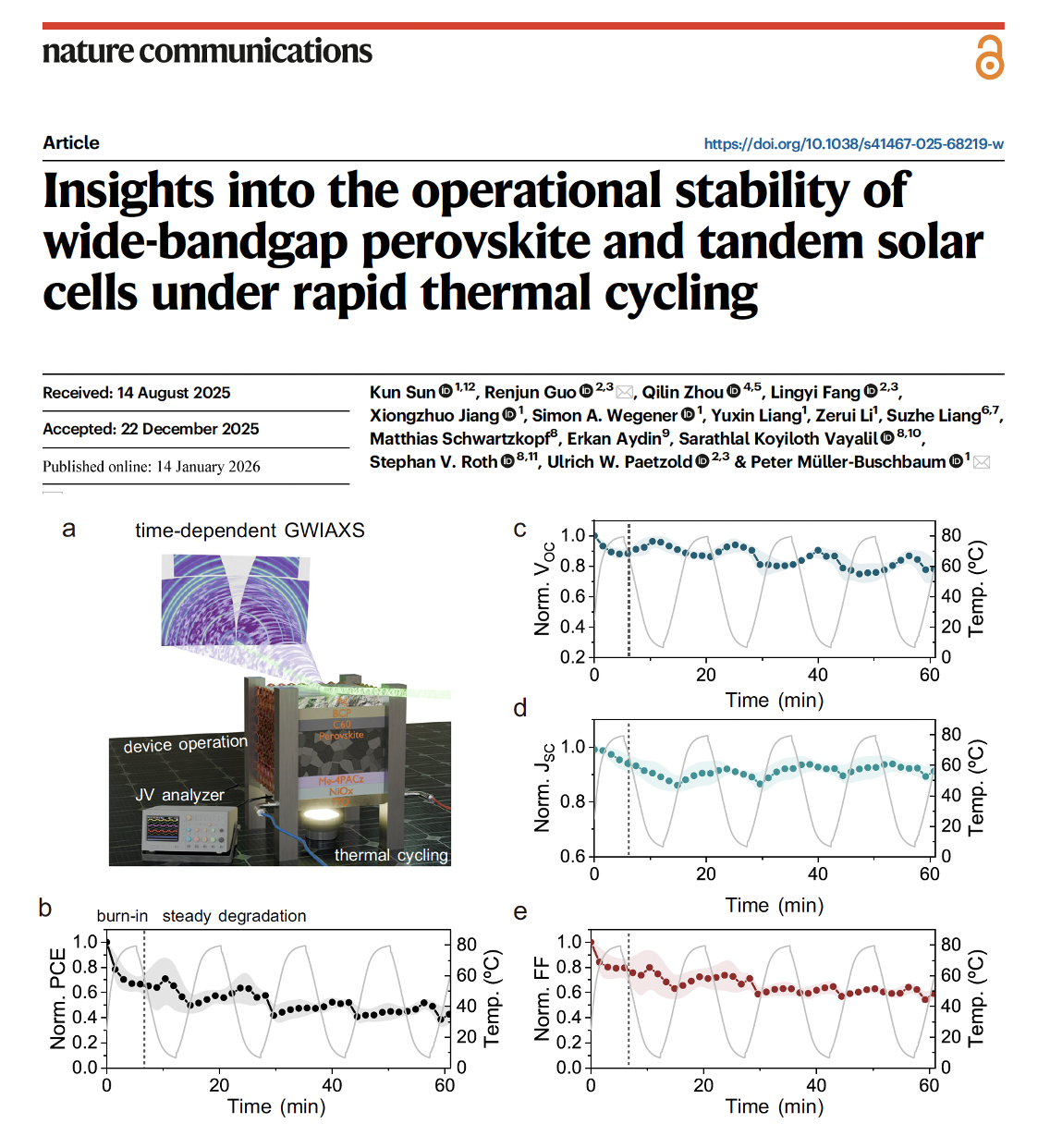
Our Recent Collaboration Reveals Understanding Thermal Stability of Wide-Bandgap Perovskite and Tandem Solar Cells under Rapid Thermal Cycling
Read more
Dr. Aydin's "INPERSPACE" project, under the framework of the ERC Starting Grant (StG), has commenced at LMU Munich
Read more